Dubai Desert Safari: Morning vs Evening – Which Is Better?
Not sure whether to book a morning or evening desert safari in Dubai? Compare dune activities, sunset views, tour duration, BBQ dinner and the shorter sunset option before choosing.
Quick answer
Quick answer
Choose a morning desert safari in Dubai if you want dune bashing, sandboarding and a camel ride in a shorter trip. Choose an evening safari if sunset views, a BBQ dinner and live performances are important to you. Neither is automatically better. It depends on how much time you have and what you want to experience.
What to know before you go
- Morning safaris are generally better for activity-focused travelers who want to keep their evenings free.
- Ganzay's featured morning safari lists a four-hour program including dune bashing, sandboarding and a camel ride; no meal is included.
- The longer featured evening safari combines dune activities with a sunset stop, BBQ buffet and live entertainment.
- Ganzay also lists a shorter four-hour evening safari without dinner or live entertainment as standard inclusions.
- Morning tours do not automatically include sunrise views; confirm the actual departure schedule.
- Quad biking is optional on the featured tours, not automatically included.
- Compare total duration, pickup arrangements, comfort requirements and cancellation terms before booking.
Verified at a glance
Key facts
- Ganzay's featured morning desert safari is described as a four-hour Al Madaam red-dunes tour with 4x4 transfers.
- The morning tour lists around 25 minutes of dune bashing, sandboarding and a 20-minute camel ride.
- The featured morning tour does not include a meal.
- Ganzay's longer evening safari lists sunset photography, a BBQ buffet and several live performances.
- The shorter four-hour evening safari lists dune activities and a sunset photo stop, but no standard BBQ dinner or live entertainment.
- Optional quad biking should not be presented as automatically included in standard tickets.
- Official Dubai tourism guidance advises season-appropriate clothing and planning for hot weather.
Here's the honest answer most guides dance around: neither is "better". They are two different days out. The morning safari is a quick, cool, adrenaline-first trip that leaves your afternoon free. The evening safari is the full Arabian night, with sunset, BBQ dinner and live shows. The right pick depends on who is travelling when you are visiting and what you want to bring home: photos, a story or a free afternoon.
Want to see what the dunes, camp and evening show look like first? Watch the Dubai desert safari video.
Below is a no-nonsense breakdown so you can decide in five minutes.
The 30-Second Answer
If this sounds like you | Book this |
|---|---|
First time in Dubai, want the "full experience" | Evening safari |
Couple, honeymoon, anniversary, birthday group | Evening safari |
Travelling with toddlers, seniors, or heat-sensitive guests | Morning safari |
Visiting May to September and hate peak heat | Morning safari |
Short stay, tight itinerary or an evening flight | Morning safari |
Want dinner, tanoura, belly dance, and a fire show | Evening safari |
Photographer chasing clean light and empty dunes | Morning (sunrise) or Evening (golden hour), depending on the look you want |
Want to sleep under the stars | Overnight safari (a different product altogether) |
Morning vs Evening Desert Safari: Side-by-Side
Morning Safari | Evening Safari | |
|---|---|---|
Typical pickup | 5:30–9:00 AM (varies by operator) | 2:30–4:00 PM |
Back at hotel | Around 10:00 AM–midday | Around 9:00–9:30 PM |
Total time | About 4–6 hours (some include extra stops) | About 6–7 hours |
Temperature feel | Cooler, especially May to September | Warmer in summer; lovely and cool from November to March |
Dune bashing | Yes, about 20–30 minutes | Yes, about 20–30 minutes |
Sandboarding | Yes | Yes |
Camel ride | Yes, short | Yes, short |
Meal | Light snack or breakfast box, drinks | BBQ buffet dinner, veg and non-veg |
Entertainment | Usually none | Tanoura, belly dance, fire show (varies) |
Henna / traditional dress | Rare | Common |
Sunset / stars | No | Yes |
Crowd level | Quieter dunes | Busiest slot of the day |
Price level | Generally lower per person, but not always (see below) | Generally higher on premium packages but shared evening deals can be very cheap |
Timings and inclusions differ between operators, so always check your exact package before paying.
What Actually Happens on a Morning Desert Safari
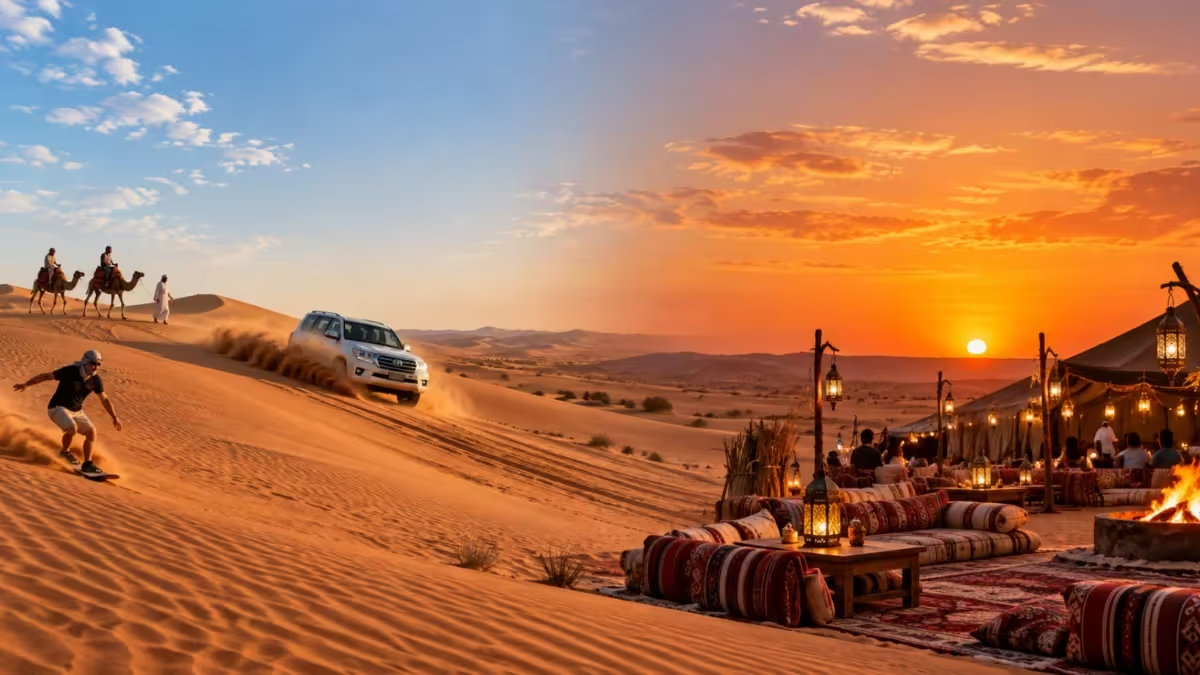
Morning safaris are the "get to the point" option. You are picked up early in a 4x4 (usually a Toyota Land Cruiser), driven out to the red dunes (commonly the Al Lahbab area, or Mleiha in Sharjah on some tours) and the action starts almost immediately.
A typical flow looks like this:
- Hotel pickup from Dubai Marina, JBR, Downtown, Business Bay, Deira or Sharjah zones.
- Tyre deflation and a quick safety briefing at the edge of the dunes. Lower tyre pressure is what gives the 4x4 grip on soft sand.
- Dune bashing, around 20–30 minutes of steep climbs, sideways slides and crest drives.
- Sandboarding on a gentle slope, which is much harder to stay upright on than it looks.
- Short camel ride and photo stops.
- Refreshments, then the drive back.
Some operators turn the morning into a longer day trip, adding Fossil Rock, Camel Rock and Hatta (the Hajar mountains, Honey Bee Garden, Heritage Village and Hatta Dam). That is a fantastic day out but it is not the same as a short sunrise dune run, so check the itinerary before you book. A "morning safari" can mean 4 hours or 6.5 hours depending on who is selling it.
Who it suits: families with young children, older travellers, people who get tired in heat, short-stay visitors and anyone who would rather keep their evening free for a dinner cruise, Burj Khalifa or a beach club.
What you give up: the sunset, the starry sky, the BBQ and the live shows.
What Actually Happens on an Evening Desert Safari
This is the classic. When people say "desert safari", this is usually what they picture. For a real example see the evening desert safari with BBQ dinner and optional quad bike.
- Afternoon hotel pickup and a drive of roughly 45 minutes to the dunes.
- Dune bashing timed so you are out in the open desert as the light turns golden.
- Sunset photo stop on a high dune. This is the shot that ends up on every Dubai holiday album.
- Sandboarding and a short camel ride.
- Camp arrival: Arabic coffee and dates, henna, traditional dress photos, falcon photos at many camps and optional shisha areas.
- BBQ buffet dinner with grilled meats, rice, salads, hummus, desserts and vegetarian options.
- Live entertainment: tanoura (the spinning Sufi-style dance), belly dance and a fire show.
- Drop-off around 9:00–9:30 PM.
Who it suits: first-timers, couples, groups, families with school-age children and anyone who wants culture, food and photos in one booking.
What you give up: a free afternoon and quiet dunes. The evening slot is the busiest of the day.
Weather: The Part That Should Decide It for Many People
Dubai's desert is not the same all year and this is where a lot of bad bookings happen. Visit Dubai's official desert safari guide is a good neutral reference for seasons and what to wear.
- November to March: Both slots are lovely. Evenings turn properly cold once the sun goes down, so bring a light jacket and trousers for the camp. This is peak season, so book early.
- April and October: Warm but comfortable. Morning is cooler, evening is still very doable.
- May to September: This is where morning pulls ahead. Afternoon pickup means you are out on hot sand in the early part of the trip. Evening safaris still run in summer, with air-conditioned vehicles and shaded camps but if heat bothers you, go in the morning.
Our tip: in summer, if you do choose evening, pick a package with an air-conditioned camp and drink water constantly.
Price: Don't Assume Morning Is Always Cheaper
Most guides tell you the morning safari is the budget option. Often that is true because there is no dinner or show to pay for. But look closely at the market and you will notice something interesting: shared evening safaris with heavy volume can be priced at or below morning tours, because operators fill the evening slot every single day and run it at scale.
As a rough guide shared safaris tend to fall in these ranges:
- Shared evening safari: roughly AED 100–200 per adult
- Shared morning safari: roughly AED 150–280 per adult (higher when it includes Mleiha or Hatta stops)
- Premium or VIP evening: several hundred AED, with private seating and a better camp
- Quad bike or dune buggy add-ons: extra, usually bookable per 30 or 60 minutes
Prices change by season and by operator. Treat these as ballparks, then compare what is included: transfers, dinner, drinks, quad time, and pickup surcharges for areas like Sharjah, Ajman or Abu Dhabi.
What to look for instead of just the cheapest number:
- Is hotel pickup included for your area?
- Is it a shared or private vehicle?
- Is dinner included, and are vegetarian or halal options confirmed?
- Are soft drinks and water unlimited?
- Is the camp standard or premium?
Photography: Sunrise vs Sunset
They give you two different pictures not a better and a worse one.
Morning gives you cleaner air, crisp contrast, long ripples in the sand and far fewer vehicles in your frame. If you want the desert without anyone else in it, morning wins.
Evening gives you warm golden-hour tones, glowing silhouettes on the dune crest, lantern-lit camp scenes, and the fire show. If you want the postcard shot, evening wins.
Pack a wide lens or wide phone mode for the dunes, and a short telephoto for camel and portrait shots. Wipe your lens often. Fine sand gets everywhere.
Morning vs Evening for Different Travellers
Families with young children
Morning is easier: shorter, cooler, back before nap time. Many operators accept children from about 3–4 years old on the safari and car seats can often be arranged, but confirm at booking. For school-age kids (6 to 11), the evening show and dinner usually win on pure fun. If you want the evening feel without the late finish, look at a 4-hour evening desert safari with camel ride.
Seniors
Morning is gentler. If someone doesn't like bumpy rides, ask about a no dune-bashing option, where the vehicle drives straight to the camp or takes a calmer route.
Couples and honeymooners
Evening, ideally on a premium or VIP package with private seating. Sunset on the dunes followed by dinner under the stars is hard to beat.
Groups and celebrations
Evening. The shows, the dinner and the camp atmosphere suit birthdays, hen and stag trips, and corporate outings.
Thrill-seekers
Morning is a smart choice if you want to add a quad bike or dune buggy, because the cooler temperatures make riding more comfortable. Evening quad slots can also be booked (see the evening safari with optional quad bike), but camps get busy.
Pregnant travellers, or anyone with back, neck, or heart conditions
Dune bashing is not recommended for these guests. Many operators offer a gentler alternative, but always check the operator's own policy and speak to your doctor first.
People who get motion sickness
Sit in the front, eat lightly beforehand and tell your driver. Cooler morning air can help and you can skip the dune bashing on most packages.
What About Ramadan and Public Holidays?
Safaris still run during Ramadan but entertainment such as music and some shows can be reduced or paused in line with local regulations, while dinner service continues. Ramadan 2027 is expected to begin around 8 February 2027, subject to the official moon-sighting announcement.
For guests who are fasting a morning safari often fits better because it finishes before midday. If you choose evening, ask the operator how they handle iftar timing at the camp.
What to Wear and Bring
- Light, breathable clothes (and a jacket for winter evenings)
- Closed shoes (hot sand and quad bikes do not mix with sandals)
- Sunglasses, a hat or scarf, and sunscreen
- A phone pouch or zip bag for sand
- Cash for optional extras like photos, shisha or tips
- A small bottle of water, even though most tours provide it
Common Mistakes to Avoid
- Booking the cheapest tour without reading the inclusions. A low price can hide pickup surcharges, paid drinks, or a crowded camp.
- Assuming every "morning safari" is the same. Some are quick 4-hour dune runs. Others are 6-hour trips with Mleiha and Hatta.
- Booking evening in peak summer with no AC plan. Ask about the camp setup.
- Leaving it to the last minute in winter. From October to April, seats can sell out. Booking a few days ahead is sensible.
- Wearing sandals or heavy perfume. Closed shoes are a must and strong scents can worsen motion sickness.
- Forgetting to confirm pickup. Check your hotel name and zone and any surcharge for areas outside central Dubai.
A Simple Way to Decide
Ask yourself three questions:
- Do I want dinner and a show? If yes, go evening.
- Do I need my afternoon or evening free, or am I travelling with little kids or in summer heat? If yes, go morning.
- Is this my only desert trip? If yes, book the evening. It's the version that feels like "the full thing".
And if you have time for two, do both (you can compare every option on our Dubai desert safari page). They feel different enough that it won't feel repetitive: one for the thrill and the light, one for the culture and the night.
Ready to Book?
Tell us your travel dates, your hotel area and who is coming and we'll recommend the right slot and package. Ready to go? Book the Morning Desert Safari with dune bashing and sandboarding, choose the Evening Desert Safari with BBQ dinner and optional quad bike or browse all Dubai desert safari packages.
Common questions
Frequently asked questions
Which is better, a morning or an evening desert safari in Dubai?+
Evening is better for first-timers who want sunset, dinner, and live shows. Morning is better for families with small children, seniors, summer visitors and anyone with a packed itinerary.
Is the morning desert safari cheaper than the evening one?+
Usually, because there is no dinner or show, but not always. Some shared evening tours are priced very competitively, while morning tours that add Mleiha or Hatta can cost more. Compare inclusions not just the headline price.
How long does each safari take?+
A morning safari typically takes 4 to 6 hours depending on the itinerary. An evening safari usually takes 6 to 7 hours, door to door.
Is dinner included in the morning safari?+
Usually not. Most morning packages include water, soft drinks, and a light snack or breakfast. Check the specific package.
Are the dune bashing and sandboarding the same in both?+
Yes. The activities are largely the same. The difference is the light, the temperature, the crowd, and what happens after at the camp.
Can I do a quad bike or dune buggy on both?+
Yes, as an add-on on many tours. Mornings are more comfortable in warm months, and you should book the slot in advance.
Is the evening safari too crowded?+
It is the busiest slot, but crowds are spread across multiple camps and convoys. If quiet dunes matter more than the dinner and show, go in the morning.
Is a desert safari safe for kids?+
Yes, with a licensed operator. Dune bashing is not recommended for infants, and you should confirm age limits and car-seat availability at booking.
Do desert safaris run during Ramadan?+
Yes. Dinner continues, but entertainment may be reduced or paused. Confirm what is running when you book.
How early should I book?+
In peak season (October to April), book at least 3 to 7 days ahead. Quad and buggy slots can go even sooner.
What should I do if I get motion sickness?+
Sit in the front, eat lightly and tell the driver. You can usually skip the dune bashing and go straight to camp.
Written by
Ganzay Travel Editorial Team
Travel Editorial Team
The Ganzay travel editorial team develops practical destination and attraction guides based on published experience details and reputable visitor resources.
View author profile