Sofia 3 Day Itinerary: Sights, Costs & Day Trips
Planning 3 days in Sofia? Follow a practical itinerary covering the historic centre, Boyana Church, current transport costs and a Rila Monastery day trip.
Quick answer
Quick answer
A practical Sofia 3-day itinerary spends Day 1 around Alexander Nevsky Cathedral and ancient Serdica, Day 2 visiting cultural sights such as Boyana Church, and Day 3 at Rila Monastery. Sofia's Metro costs from €0.80 per journey, and Bulgaria has used the euro since January 2026.
What to know before you go
- Sofia works well as a three-day city break.
- Keep the historic centre together on Day 1.
- Use Day 2 for Boyana and deeper cultural sightseeing.
- Give Rila Monastery a full-day slot.
- Use Plovdiv as an alternative, not an addition to Rila.
- Metro fares currently start at €0.80.
- Bulgaria now uses the euro.
- Verify changing museum and transport schedules before travel.
Verified at a glance
Key facts
- Sofia flight-search interest was reported up 136% year over year in KAYAK 2026 travel trends — verified 2026-08-31.
- Bulgaria adopted the euro on 1 January 2026 — European Commission, verified 2026-08-31.
- Sofia Metro single fare is €0.80 — Metropolitan Sofia, verified 2026-08-31.
- Sofia Airport Terminal 2 is connected to central Sofia by Metro M4 — Metropolitan Sofia, verified 2026-08-31.
- Boyana Church is UNESCO World Heritage-listed — UNESCO, verified 2026-08-31.
- Rila Monastery is UNESCO World Heritage-listed — UNESCO, verified 2026-08-31.
- Rila Monastery combined museum ticket is €12 — official Rila Monastery, verified 2026-08-31.
- The current English Rila Monastery transport page does not list a direct public bus from Sofia — official Rila Monastery, verified 2026-08-31.
- Regional History Museum Sofia has temporary opening hours through 5 September 2026 — official museum notice, verified 2026-08-31.
Three days in Sofia gives a first-time visitor enough time to see the historic centre without rushing, explore one of the city's outer cultural sights and use the final day for a major excursion such as Rila Monastery. Sofia's centre is compact, public transport is inexpensive and the airport is directly connected to central Sofia by Metro. Bulgaria has also used the euro since January 2026, making trip budgeting simpler for many European visitors.
This itinerary spends Day 1 in historic central Sofia, Day 2 on culture and Boyana and Day 3 at Rila Monastery, with Plovdiv included as an alternative for travelers who prefer another city.
Direct answer
For a first visit, spend Day 1 around Alexander Nevsky Cathedral, Serdica and central Sofia; use Day 2 for the Regional History Museum, Boyana Church and Vitosha Boulevard; and reserve Day 3 for Rila Monastery. Sofia public transport costs from €0.80 per journey, while central sightseeing can largely be done on foot.
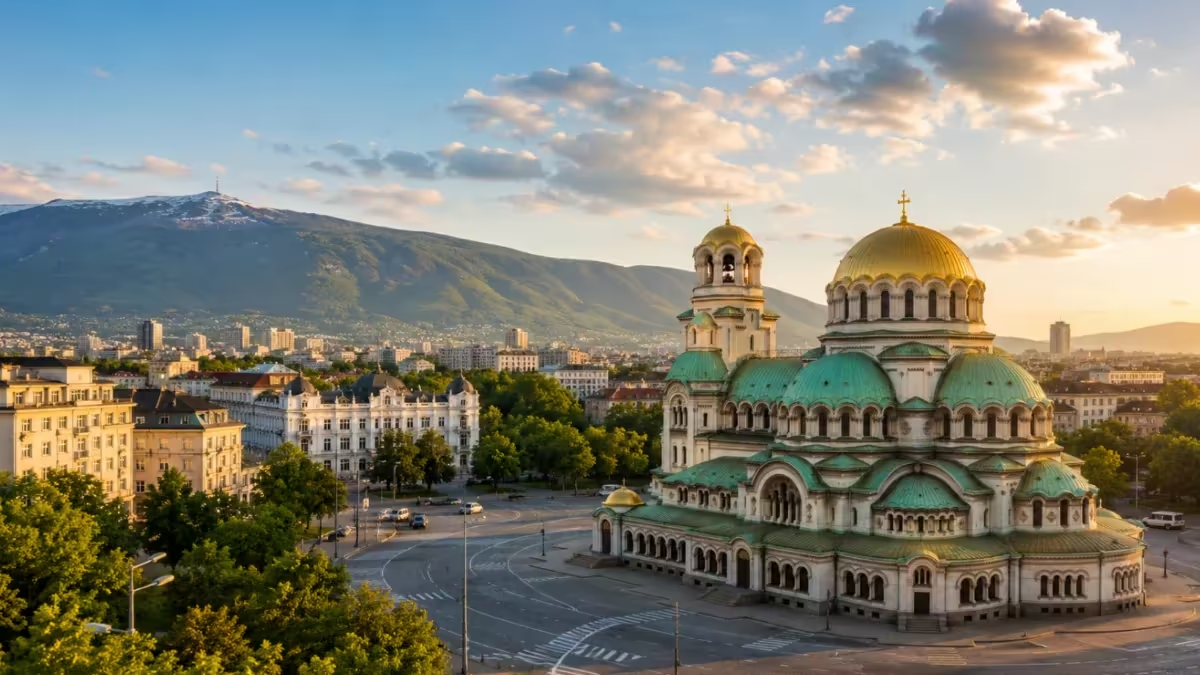
Begin your first morning at St Alexander Nevsky Cathedral, one of Sofia's defining landmarks.
Visit Sofia currently lists the cathedral's opening hours as 7:00 AM to 5:30 PM. Because religious-site schedules may change for services or special occasions, check again shortly before visiting.
The cathedral also places you close to several important cultural and religious landmarks, making it an efficient starting point rather than a sight you need to travel across town to reach later.
Walk toward ancient Serdica
Continue west through central Sofia toward the Serdica Ancient Cultural and Communicative Complex.
The archaeological area is integrated directly into modern central Sofia beneath and around Nezavisimost Square. Visitors can see parts of streets, buildings, drainage systems and other remains of Roman Serdica.
This is one of Sofia's strongest contrasts: Roman remains sitting under the administrative centre of a modern European capital.
Find St George Rotunda
Nearby, the St George Rotunda stands inside the Presidency courtyard.
Visit Sofia describes the Rotunda as a nationally significant architectural, archaeological and art monument, with its origins associated with the Roman city of Serdica.
The Serdica archaeological area and Rotunda are close enough that separating them into different sightseeing days would waste time.
Continue to the Central Mineral Baths area
Walk toward Banski Square and the former Central Mineral Baths building, which now houses the Regional History Museum – Sofia.
If you arrive late on Day 1, save the museum interior for Day 2 and simply explore the surrounding area.
End on Vitosha Boulevard
Finish with a walk along Vitosha Boulevard, the city's main central pedestrian street.
This works particularly well at the end of the sightseeing day because you are no longer working around museum closing times.
Editorial recommendation: do not schedule every church and museum into your first day. Sofia rewards walking between layers of history rather than rushing between entrances.
Day 2: Sofia culture, Boyana and city life
Morning: Regional History Museum
Return to the Regional History Museum if you want a structured overview of Sofia's development.
There is an important current-hours warning.
Between 11 August and 5 September 2026, the museum's main building is temporarily operating 9:00 AM–3:00 PM, Tuesday–Sunday. Its regular published schedule is 10:00 AM–6:00 PM, Tuesday–Sunday, with Monday closed.
Anyone publishing or reading this guide after 5 September should recheck the museum website rather than relying on the temporary August schedule.
Afternoon: Boyana Church
Next, head out toward Boyana Church.
The church has been on UNESCO's World Heritage List since 1979 and is particularly significant for its medieval wall paintings, including frescoes dated to 1259.
Visit Sofia's own suggested route pairs Boyana Church with the National Museum of History, making the two a logical cultural combination if your interests lean strongly toward Bulgarian history.
Public transport from the central Vitosha Boulevard area to Boyana can take considerably longer than moving around Sofia's central core, so do not treat it as a quick stop between central museums.
Evening: return to central Sofia
Return toward the centre and use your final city evening for Vitosha Boulevard, nearby streets or a relaxed dinner.
This is intentionally lighter than Day 1.
A good three-day itinerary should leave some flexibility for weather, queues, meals and attractions that hold your interest longer than expected.
Day 3: Rila Monastery day trip
For most first-time visitors, Rila Monastery is the strongest way to use Day 3.
UNESCO describes the monastery as a major spiritual and cultural centre founded in connection with St John of Rila and inscribed it on the World Heritage List in 1983.
Important transport update
This is an area where outdated travel blogs can cause problems.
The monastery's current official English transport page says access is now by:
- private transport;
- organized transport;
- transport arranged by travel agencies; or
- bus to Blagoevgrad followed by taxi to the monastery.
For a visitor with only three days, organized transport or a private vehicle is therefore the simplest editorial recommendation.
Do not build your itinerary around an old direct Sofia–Rila public-bus timetable without confirming it.
Rila Monastery museum costs
The monastery's museums currently offer a combined ticket for €12, purchased on site.
The museum exhibitions generally operate 8:30 AM–4:30 PM, with extended summer schedules applying to some exhibitions from June through September.
The main monastery church operates on a different schedule, so check the official site for the specific day you plan to visit.
Alternative Day 3: Plovdiv
Not everyone wants a monastery day trip.
If you prefer another historic city, Plovdiv is the strongest alternative.
Official Visit Plovdiv information confirms connections from Sofia by both bus and train and directs rail travelers to Bulgarian State Railways for live schedules.
Rail works have affected the Sofia–Plovdiv corridor during the 2026 timetable, so do not hard-code one train departure into an evergreen itinerary. Check the current BDZ timetable immediately before travel.
Which should you choose?
Choose Rila Monastery if: you want one of Bulgaria's principal religious and cultural heritage sites.
Choose Plovdiv if: you prefer another city, architecture, streets, food and urban history.
Stay in Sofia instead if: you dislike day-trip travel and want more museums, Boyana or Vitosha-area time.
How much does 3 days in Sofia cost?
I would avoid publishing a fake universal “€X per day” number because accommodation and restaurant prices change constantly.
The costs we can verify are more useful.
| Expense | Current verified cost |
|---|---|
| Metro single ticket | €0.80 |
| Ticket 30+ | €0.80 |
| Ticket 60+ | €1.10 |
| Calendar-day public transport pass | €2 |
| 24-hour transport card | €3 |
| 72-hour transport card | €7.60 |
| Rila Monastery combined museum ticket | €12 |
Accommodation, meals, flights and organized Rila transport should be priced separately for the actual travel dates.
Metro M4 connects Sofia Airport Terminal 2 with central Sofia.
Sofia's official tourism planning material gives an airport-to-centre journey of roughly 25 minutes, while the direct Metro reaches central Serdika without requiring a line change.
Travelers arriving at Terminal 1 should confirm the current airport-terminal shuttle arrangement before travel.
A single Metro ticket costs €0.80 under the current 2026 fare structure.
Getting around Sofia
For Day 1, walking will cover much of the itinerary.
For Boyana and other outer districts, public transport becomes more useful.
Contactless bank-card payment is available for eligible Sofia public transport tickets, including Ticket 30+.
If you expect to use several rides in a day, compare the single-ticket cost with the available day products rather than buying separate tickets automatically.
Where should first-time visitors stay?
For this itinerary, the most convenient area is central Sofia around Serdika, Vitosha Boulevard or the historic core.
That is an editorial recommendation, not an official ranking of Sofia neighborhoods.
The advantage is logistical: most Day 1 sights become walkable, the Metro is easy to reach, and evenings do not require long journeys back from the centre.
Is three days enough in Sofia?
Yes, for a first visit.
Three days gives you enough time to see Sofia's historic centre, add one outer-city cultural excursion and include a major day trip without trying to see everything.
Official tourism data currently shows an average visitor stay exceeding 2.3 days, reinforcing Sofia's role as more than a quick transit stop.
If you want Vitosha hiking, multiple museums, Plovdiv and Rila Monastery, four or five days would be more comfortable.
Best time to visit Sofia
There is no universally best month.
For a three-day sightseeing trip, prioritize the type of experience you want:
Spring and autumn: comfortable city exploration and day-trip planning.
Summer: long daylight hours, but plan for warmer daytime conditions.
Winter: a very different city atmosphere, with nearby mountain activities potentially becoming part of the trip.
Exact weather should always be checked immediately before travel rather than predicted from an evergreen blog.
Common Sofia itinerary mistakes
- trying to fit Rila Monastery into half a day;
- using old Rila direct-bus information without verifying it;
- placing Boyana Church between tightly scheduled central sights;
- assuming all museum hours remain unchanged;
- forgetting that Bulgaria now uses the euro;
- scheduling Rila and Plovdiv inside the same three-day visit;
- building every hour of all three days with no flexibility.
Practical planning summary
Official facts
Sofia Airport has direct Metro access from Terminal 2.
Bulgaria uses the euro.
Boyana Church and Rila Monastery are UNESCO World Heritage Sites.
Rila Monastery's official English page does not currently list a direct scheduled public bus from Sofia.
Editorial recommendations
Walk central Sofia on Day 1.
Use Day 2 for one or two longer cultural stops.
Give Rila Monastery most of Day 3.
Stay around the historic centre if this is your first visit.
Reconfirm before travel
- museum opening hours;
- Rila transport;
- attraction ticket prices;
- train schedules;
- airport-terminal shuttle arrangements;
- individual attraction closures.
Planning your Sofia trip with Ganzay
No Sofia-specific Ganzay destination or experience URL was reliably verified during this research, so no unverified internal product link has been added.
Explore travel experiences on Ganzay and compare available options for your next city break.
Frequently asked questions
Is three days enough for Sofia?
Yes. Three days is enough for the central sights, one outer-city cultural area and either Rila Monastery or another substantial excursion. If you also want Plovdiv, mountain hiking and several museums, add more time.
Start around Alexander Nevsky Cathedral, then walk through the central historic area toward Serdica, St George Rotunda and Banski Square. Finish around Vitosha Boulevard. This keeps most of the day geographically compact.
Rila Monastery is a strong choice for a first Bulgaria trip, especially if cultural heritage is important to you. It is UNESCO-listed and needs most of a day.
The monastery's current official English transport guidance does not list one. It currently recommends private transport, organized travel or reaching Blagoevgrad and continuing by taxi.
Choose Rila for religious heritage and a rural mountain setting. Choose Plovdiv if you prefer another historic city. Both are valid Day 3 choices, but trying to do both in the same day would be impractical.
A standard Metro ticket currently costs €0.80. A calendar-day pass is €2, while 24-hour and 72-hour products are also available.
Yes. Bulgaria adopted the euro on 1 January 2026.
Most of the Day 1 route in this itinerary can be covered on foot. Outer sights such as Boyana require transport, so it is still useful to understand Sofia's Metro and surface transport network.
For this itinerary, central Sofia around Serdika or Vitosha Boulevard is the easiest editorial choice because it reduces travel time to the historic centre.
The monastery currently sells a combined museum ticket for €12, according to its official website.
Yes. Official Visit Plovdiv information confirms bus and rail links from Sofia. Check live BDZ train schedules because railway works can affect journey planning.
Yes. M4 connects Terminal 2 with central Sofia, including Serdika.
A Sofia 3 day itinerary works best when you resist the temptation to fill every hour. Use the first day for the compact historic centre, give the second day to deeper cultural sights such as Boyana Church, then choose one meaningful excursion for Day 3.
For most first-time visitors, Rila Monastery is the strongest third-day choice. Plovdiv is the better alternative if another historic city appeals more than a monastery.
The practical advantages are significant: Sofia's centre is walkable, public transport is inexpensive, the airport connects directly to the Metro, and Bulgaria now uses the euro. Build in some flexibility, verify changing hours before travel and let the city take more than a checklist to reveal itself.
Common questions
Frequently asked questions
Is three days enough for Sofia?+
Yes. Three days is enough for the central sights, one outer-city cultural area and either Rila Monastery or another substantial excursion. If you also want Plovdiv, mountain hiking and several museums, add more time.
What should I do on my first day in Sofia?+
Start around Alexander Nevsky Cathedral, then walk through the central historic area toward Serdica, St George Rotunda and Banski Square. Finish around Vitosha Boulevard. This keeps most of the day geographically compact.
Should I visit Rila Monastery from Sofia?+
Rila Monastery is a strong choice for a first Bulgaria trip, especially if cultural heritage is important to you. It is UNESCO-listed and needs most of a day.
Is there a direct public bus from Sofia to Rila Monastery?+
The monastery's current official English transport guidance does not list one. It currently recommends private transport, organized travel or reaching Blagoevgrad and continuing by taxi.
Rila Monastery or Plovdiv: which is better?+
Choose Rila for religious heritage and a rural mountain setting. Choose Plovdiv if you prefer another historic city. Both are valid Day 3 choices, but trying to do both in the same day would be impractical.
How much is public transport in Sofia?+
A standard Metro ticket currently costs €0.80. A calendar-day pass is €2, while 24-hour and 72-hour products are also available.
Does Bulgaria use euros?+
Yes. Bulgaria adopted the euro on 1 January 2026.
Is central Sofia walkable?+
Most of the Day 1 route in this itinerary can be covered on foot. Outer sights such as Boyana require transport, so it is still useful to understand Sofia's Metro and surface transport network.
What is the best area to stay for first-time visitors?+
For this itinerary, central Sofia around Serdika or Vitosha Boulevard is the easiest editorial choice because it reduces travel time to the historic centre.
How much is the Rila Monastery museum ticket?+
The monastery currently sells a combined museum ticket for €12, according to its official website.
Can I visit Plovdiv as a day trip from Sofia?+
Yes. Official Visit Plovdiv information confirms bus and rail links from Sofia. Check live BDZ train schedules because railway works can affect journey planning.
Is Sofia Airport connected by Metro?+
Yes. M4 connects Terminal 2 with central Sofia, including Serdika.
Written by
Ganzay Travel Content Team
Travel Content Team
Ganzay's travel content team prepares practical destination and attraction guides using current official and reputable sources, with a focus on clear planning information and transparent travel advice.
View author profile